
Overview
Nobody can deny that swing rhythm and tempo are important in golf. In this guide, we'll find out what swing rhythm and tempo are, why they're important, and how to practice developing your own rhythm like a pro.
What are rhythm and tempo in golf?
Swing Rhythm and Tempo
In golf, rhythm refers to the sequence of movement or the flow of the swing and is expressed as "backswing:downswing." Backswing refers to the period from the address to the top of the backswing, while downswing refers to the period from the top of the backswing to impact. For example, John Doe takes 0.9 seconds from the address to the top of the backswing and 0.3 seconds from the top of the backswing to impact, which makes his swing rhythm 3:1.
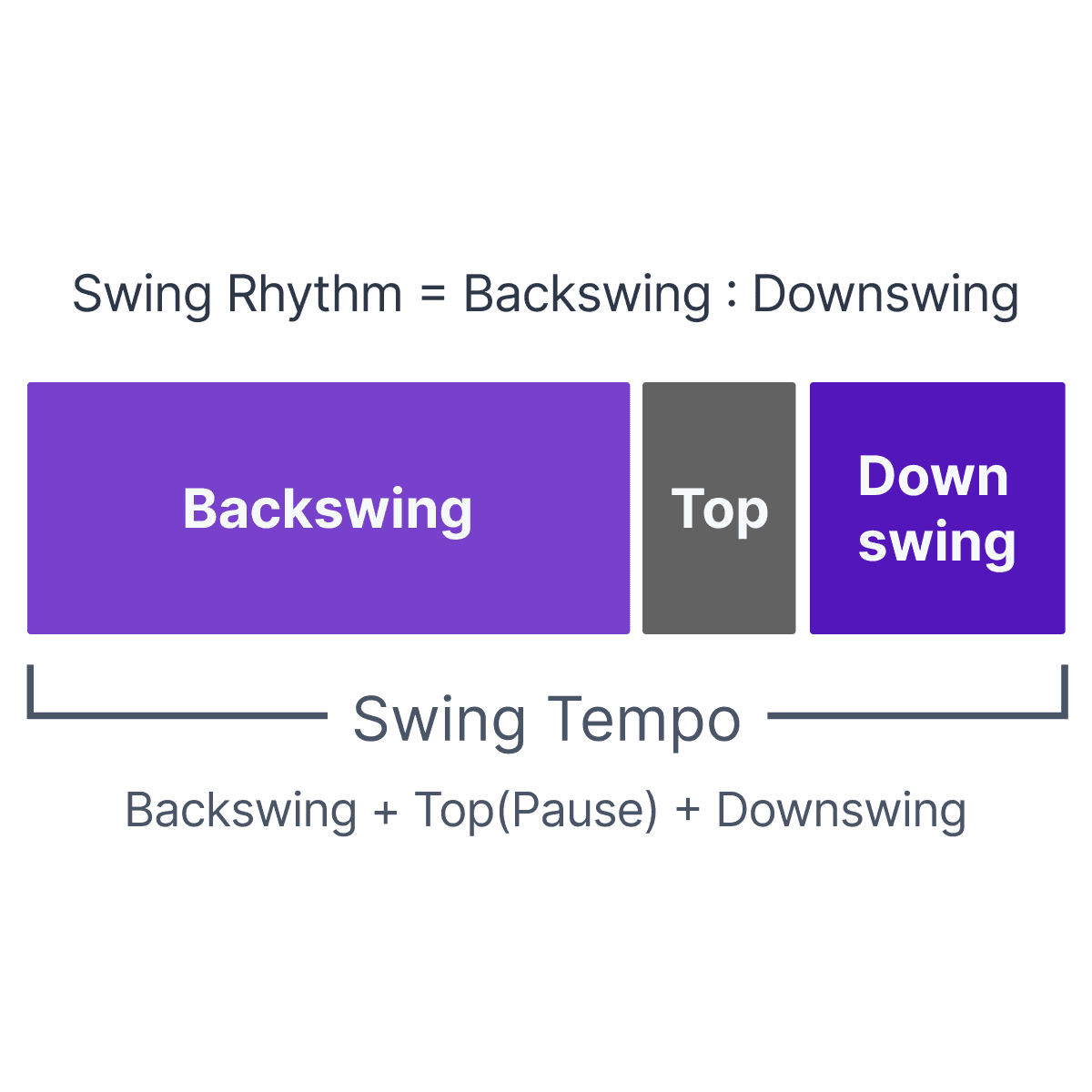
Swing tempo refers to the time it takes for the backswing, pause at the top, and downswing from address to impact. You may understand terms like address and downswing, but what is a pause at the top?
What is a Pause at the Top?
A pause at the top, or pause, refers to the delay while transitioning from the backswing to the downswing. You may have heard the phrase "pause at the top of the backswing" in a lesson or on YouTube, but what does it mean to “stop” your swing?
Generally, a swing starts by slowly rotating your lower body at the top of the backswing, then rotating your upper body and arms. In this transition, the pause helps control the flow and timing of the swing. Even a pause for a fraction of a second can change the swing. How should you stop? Check out the video below for more information.
Why are Rhythm and Tempo Important in Golf?
Most golfers swing with a lot of tension especially when they are on the field or in front of a ball, causing their swing focus to become blurry and not being able to hit the ball as usual. As a result, slices, hooks, or topping tend to occur, and the distance is shorter than usual. Therefore, it is necessary to practice swings with a consistent rhythm and tempo. If you don't lose your rhythm, you can send the ball in any direction you want at any distance, regardless of the weather or situation. Like a pro.
What is a Good Rhythm and Tempo?
What is a so-called "good rhythm," and what rhythm do pro golfers have? We analyzed the rhythm and tempo data of several professional golfers. At first, we thought that each pro golfer would have a different rhythm, but the results were surprising. Most professional golfers have a rhythm of about 3:1 (about 4:1 for female pros), and a downswing of less than 0.25 seconds. For non-pros, a rhythm range of 3:1 to 4:1 and a downswing of 0.3 seconds is recommended. The pause at the top is distributed differently for each golfer's swing style, ranging from 0.02 seconds to 0.2 seconds, so we recommend avoiding no pause or too long.
If you want to know more about other swing rhythms, check out
the swing rhythm examples.👉How to Practice with a Good Rhythm
There are methods like counting ‘1-2-3’ or ‘1-2-3-1’, to feel the rhythm and tempo Yet, while practicing, you might find yourself pondering, "💬Is this rhythm accurate?” Hence, we've developed a unique feature, a Focus Drill, that gauges and facilitates your rhythm and tempo practice! Define your rhythm objectives. Each time you take a swing, we'll demonstrate how to inch closer to your intended rhythm benchmark. Upon completing your Focus Drill session, a comprehensive report will be at your disposal. Evaluate your proximity to the target through the accuracy score, and assess the consistency of your rhythmic swings through the consistency score. Furthermore, elaborate practice insights are presented on a graph.